$$\newcommand{\mtn}{\mathbb{N}}\newcommand{\mtns}{\mathbb{N}^*}\newcommand{\mtz}{\mathbb{Z}}\newcommand{\mtr}{\mathbb{R}}\newcommand{\mtk}{\mathbb{K}}\newcommand{\mtq}{\mathbb{Q}}\newcommand{\mtc}{\mathbb{C}}\newcommand{\mch}{\mathcal{H}}\newcommand{\mcp}{\mathcal{P}}\newcommand{\mcb}{\mathcal{B}}\newcommand{\mcl}{\mathcal{L}} \newcommand{\mcm}{\mathcal{M}}\newcommand{\mcc}{\mathcal{C}} \newcommand{\mcmn}{\mathcal{M}}\newcommand{\mcmnr}{\mathcal{M}_n(\mtr)} \newcommand{\mcmnk}{\mathcal{M}_n(\mtk)}\newcommand{\mcsn}{\mathcal{S}_n} \newcommand{\mcs}{\mathcal{S}}\newcommand{\mcd}{\mathcal{D}} \newcommand{\mcsns}{\mathcal{S}_n^{++}}\newcommand{\glnk}{GL_n(\mtk)} \newcommand{\mnr}{\mathcal{M}_n(\mtr)}\DeclareMathOperator{\ch}{ch} \DeclareMathOperator{\sh}{sh}\DeclareMathOperator{\th}{th} \DeclareMathOperator{\vect}{vect}\DeclareMathOperator{\card}{card} \DeclareMathOperator{\comat}{comat}\DeclareMathOperator{\imv}{Im} \DeclareMathOperator{\rang}{rg}\DeclareMathOperator{\Fr}{Fr} \DeclareMathOperator{\diam}{diam}\DeclareMathOperator{\supp}{supp} \newcommand{\veps}{\varepsilon}\newcommand{\mcu}{\mathcal{U}} \newcommand{\mcun}{\mcu_n}\newcommand{\dis}{\displaystyle} \newcommand{\croouv}{[\![}\newcommand{\crofer}{]\!]} \newcommand{\rab}{\mathcal{R}(a,b)}\newcommand{\pss}[2]{\langle #1,#2\rangle} $$
Bibm@th
Lien copié  ✅

Formulaire - Relations métriques dans le triangle
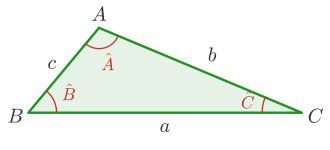
Triangle ABC, côtés a, b, c et angles

Dans tout ce qui suit, $ABC$ est un triangle, $a=BC$, $b=CA$ et $c=AB$ sont les longueurs de ses côtés, et $\hat A$, $\hat B$, $\hat C$ ses angles.

  • Formule d'Al-Kashi : $$a^2=b^2+c^2-2bc\cos(\hat A).$$
  • Inégalité triangulaire : $$|b-c|\leq a\leq b+c$$ (les inégalités sont strictes pour un triangle non aplati).
  • Surface et rayon du cercle circonscrit : $R$ est le rayon du cercle circonscrit à $ABC$, $S$ la surface de $ABC$ : $$\frac{a}{\sin\hat A}=\frac{b}{\sin\hat B}=\frac{c}{\sin\hat C}=\frac{abc}{2S}=2R,$$ $$abc=4RS.$$
  • Périmètre et aire (formule de Héron) : si $p$ désigne le demi-périmètre ($2p=a+b+c$), alors $$S=\sqrt{p(p-a)(p-b)(p-c)}.$$
  • Rayon du cercle inscrit : $r$ désigne le rayon du cercle inscrit. $$S=pr.$$
  • Centre de gravité : $G$ désigne le centre de gravité de $ABC$. Il est situé aux $2/3$ de chaque médiane à partir du sommet, et vérifie : $$GA^2+GB^2+GC^2=\frac13(a^2+b^2+c^2).$$